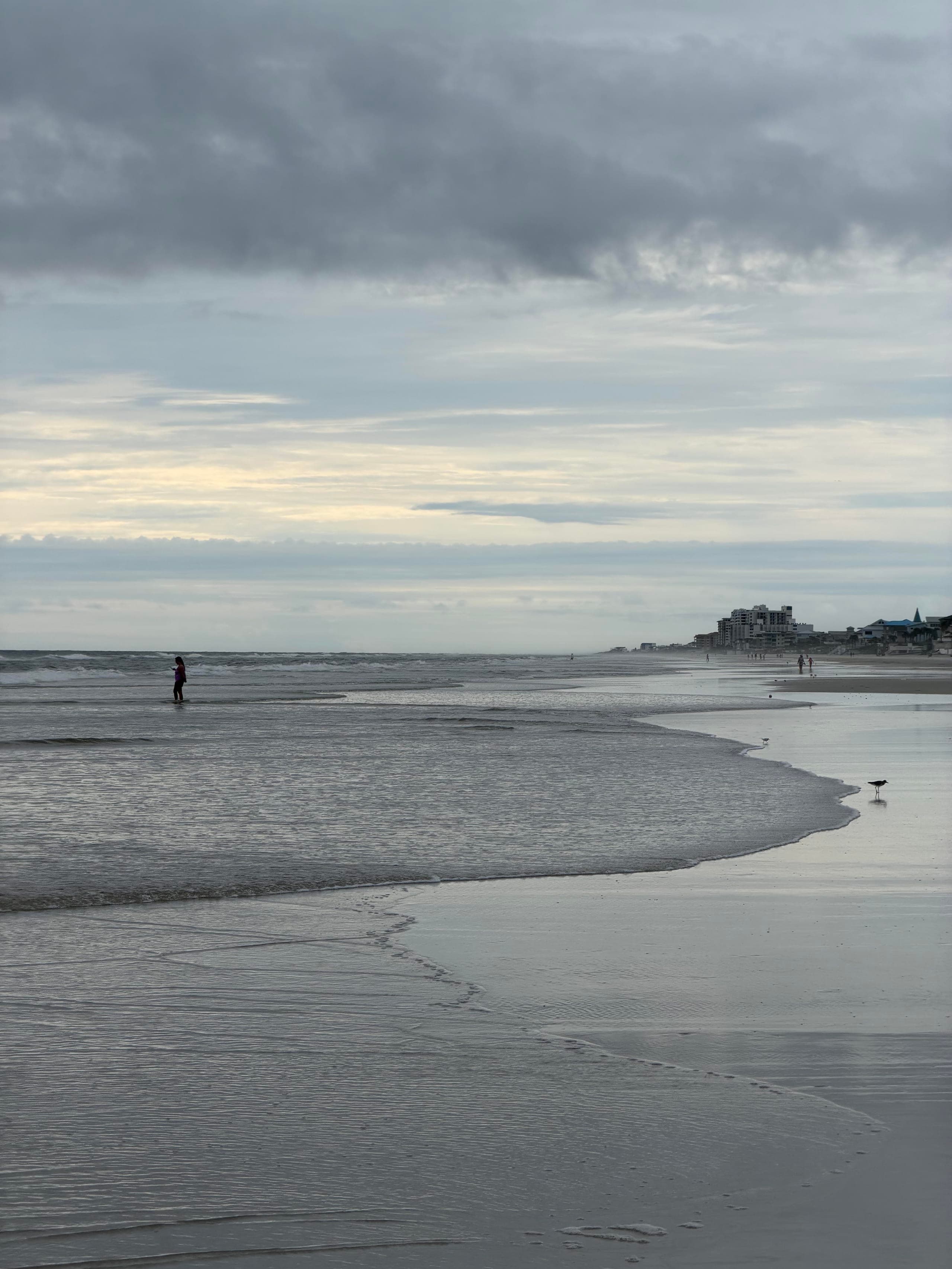
In which the railing stays worried long after everyone else calms down.
And Then They Went Home
We often obey the memories of people we've never met, and doing so, when you really think about it, is a strange type of societal knowledge transfer and a key benefit of being human.
Don't stand there. Definitely DO NOT open this while the machine is running. Keep your hands inside. Slow down. This door must remain unlocked during business hours. That mushroom: big nope.
Behind a number of these instructions and standing orders is an unhappy story, or a very close and serious brush with an unhappy story. Pain, fire, a kid wandered somewhere a kid should definitely not be. After any of these things, people likely stood around with that steely-eyed, special clarity only ever available immediately after a disaster. And then they changed something.
Which, yeah, of course.
Generally the processing of a scary event into something protective is how we get better at staying alive.
I don't particularly want to live in a world where every generation is forced to independently rediscover why stairwells need railings, why highways need guardrails. When I step onto an airplane, I'm immediately reminded there are definitely some lessons where "trust us on this one" is perfectly acceptable. I trust you, air traffic control, please and thank you. Hope the WiFi works.
But, over time, as that event fades into days, months, years, there's something odd about what happens.
Fear dissipates as people get on with their lives. They go home and have lunch. Their memories get fuzzier in a human, ordinary way. What exactly happened? Was it before lunch? Was the worry machine (e.g., the rule or whatever) running yet? Eventually the story is edited down to one or two details somebody is confident about and the rest is up for permanent debate.
That stairway railing, those warning labels, they maintain exactly the same amount of alarm they had at the beginning. Compare that to the rule creators, who, over time, calm down. We can turn what once terrified us into dinner stories. Yet our structures, rules, and regulations built in response to our initial terror don't calm with us. They often stay indefinitely worried on our behalf. Events might disappear into the background, or disappear completely, while the reaction to those events becomes just a part of the scenery.
You stop seeing and questioning the railing, which is now just a peculiar group memory. You hold it.
Guardrails good at their jobs keep those cars from disappearing down the cliff the pioneers named Blood Gulch. You battle a bottle of Advil and its childproof cap (you are an adult), and maybe you realize the cap is good at the job it was given. Maybe not. Why even have this stupid, stupid cap?
The absence of disaster feels normal because that's what normal is, and normal days create a situation I like to think about all the time: the better a safeguard performs, there will be less evidence lying around that it was even needed in the first place.
Sometimes I get off a flight and laugh to myself on what I don't say to the crew telling me goodbye at the front of the plane: "Tremendous work today on all the midair collisions and crashes we avoided." Day to day, we mostly experience safety measures as slight inconveniences, tiny delays, ugly little railings. 'Sometimes it's just extra steps or things beeping at us (just needs new batteries).
There's a half-life on the long-term reputation of any given rule.
Eventually someone encounters the rule without encountering any of the fear that caused that rule to be instantiated like Mario, new to the level. Now all they can see is the cost. Door: closed. Bottle: tricky to open. Why am I fighting a bottle designed to also be a puzzle? And it can be hard, outside of our area of expertise, to fully reason from first principles or walk the entire idea from point A (problem) to Z (rule).
Why do I think about this so much? I believe this is basically behind most of the either/or debates we have. Strip politics to its studs, and isn't it mainly this? We have too many regulations! This should be regulated! Family dispute? This isn't how we do things around here! We should do things differently around here!
It's uncomfortable. It's a problem because we're often arguing about things when we haven't yet experienced the bad outcome; as an example, I intuitively get oven mitts and haven't ever put my hand directly on the stove burner. But I also know a rule can be obsolete because it is, and it can look obsolete because it worked.
Squint at a rule, really look at it, and a lot of the time you can't tell if you're staring at accumulated wisdom or lingering, residual fear. They can both look the same.
Blood Gulch once claimed a lot of cars. Or did it? Was someone just really worried it might? Either case can produce a guardrail. In both cases, you're driving by, slowly, not careening over the embankment.
The world we inherit is chock full of other people's conclusions, and quite little of the evidence that was front and center, to them, when they made that specific conclusion. Sometimes we're the beneficiary of an old fear handled exactly right. Sometimes we're still paying for unwarranted panic from 1963. Most of the time we don't know which; we don't have enough to call it one way or another.
I think a lot about the first person who discovered a certain kind of mushroom was poisonous. Was there a person? Or by that point, had enough mushrooms with red little dots made enough people sorry that we kind of just knew...big nope on that one.
Accumulated human knowledge usually gets to us a little scattershot, from people who had to deal with real problems right in front of them, or problems they thought might be there if they didn't do something.
Some of those people saved our lives, some were overreacting. Both sets left us the same instruction either way: don't do that.
And then they went home.
Footnotes
Nonsense travels well too, which is the most obvious bug in how inherited knowledge works. I've always loved the iconography of Tarot decks, and if you read about them, pretty soon you'll learn some of the rules. Or: superstition.
You can't buy your first deck. It has to be given. When exactly did the universe decide to care about the commercial order of operations for your cards? No one knows.
Folklore is great at generating what could be called rules, and those rules might last a long time without an underlying problem keeping it going. Repetition can be enough.
The same human machinery that can carry "don't eat that mushroom" forward for generations is perfectly happy carrying this kind of stuff. Inconvenient for us.
The easiest way to encounter this ongoing concern of human life is to spend a bit of time where you don't live and start logging every time you can feel how little of the local knowledge and logic you possess.
Go somewhere sea turtles nest and at first the beach will seem weirdly dark at night. Then you will notice the porch lights and street lights that are there are red. And dim. And low-mounted. Then the next day, you see a section of sand roped off that everybody seems quite serious about you not walking through.
If you're curious, eventually you Google and discover these things are intertwined. Our lights outshine the ocean horizon, which can dissuade nesting turtles from making a nest. But the lights are especially confusing to the hatchlings, who already face long odds in their raw struggle to exist. So, beach lighting was restricted to help cute baby turtles and suddenly the darkness, the red bulbs, and the patch of sand you're not supposed to touch are all one idea.
I'd never have worked all of that out during a week at the beach. It's hard enough figuring out where to get coffee.
Somebody else, or more likely, a whole bunch of people have spent years learning enough about a problem that you can inherit a strangely specific instruction and benefit from reasoning you never personally had to perform. Entire communities can learn, quickly, how to not interfere with a baby turtle's first steps.
Of course, from your perspective it initially looks like: why is this beach so dark? Don't these people have lights?
For the first kind, ancient Rome gives us purple. Certain purple garments were restricted, heavily, in part because "Tyrian" purple depended on extraordinary amounts of labor to produce expensive dye made from small sea snails. Eventually as a species we got much better at making purple. That scarcity disappeared, as did the Empire, and with it most of the reasoning for this particular rule.
For the second kind, look at Y2K. Enormous amounts of money went to fixing government and company systems before the year 2000 arrived. Then, the night of, mostly nothing happened. And now, that's at least one reason Y2K is now remembered as a panic. Planes didn't fall from the sky. The computers ticked over successfully and Times Square didn't implode.
Sometimes a rule is obsolete because the world changed, and sometimes it only looks that way because the prevention worked.
| First published | 2024 |
|---|---|
| Reading time | 8 min |
| Tags | standards, effectiveness |
Reply
I’d welcome your thoughts on this essay. Send me a note →